

Key Takeaways
- Dual-shaft blenders deliver enhanced mixing uniformity across a wide range of food products.
- Advanced technologies in these mixers reduce production time, increase throughput, and save energy.
- Careful evaluation of factory needs ensures successful integration and maximum return on investment.
Table of Contents
- Introduction
- Understanding Dual Shaft Blenders
- Key Benefits in Food Production
- Applications in the Food Industry
- Technological Advancements
- Considerations for Implementation
- Conclusion
Introduction
In today’s highly competitive food manufacturing landscape, process efficiency and product consistency are essential to meeting consumer expectations and regulatory standards. The adoption of advanced mixing equipment, such as dual shaft blenders, has become increasingly important in ensuring uniformity, reducing batch variability, and boosting production throughput.
These blenders are specially engineered to manage complex ingredient mixtures with speed and accuracy, making them a valuable asset across diverse food processing applications. As formulations become more intricate and consumer demand for consistency soars, having the right equipment is no longer optional—it’s a competitive necessity for manufacturers aiming for quality and efficiency at scale.
Efficiency gains aren’t just about faster output; they also lead to reduced waste, improved food safety, and savings on both energy and labor. With the increasing diversity of product lines—ranging from spreads and sauces to doughs and creamy fillings—the reliability and flexibility of twin-shaft mixers enable food makers to tackle even the most demanding recipes confidently.
Integrating the right mixer into a processing line can be a game-changer, especially as food companies look to keep up with rapid trends and evolving consumer palates. Dual shaft mixers not only improve operational flow but also help uphold strict industry quality benchmarks for every batch produced.
Understanding Dual Shaft Blenders
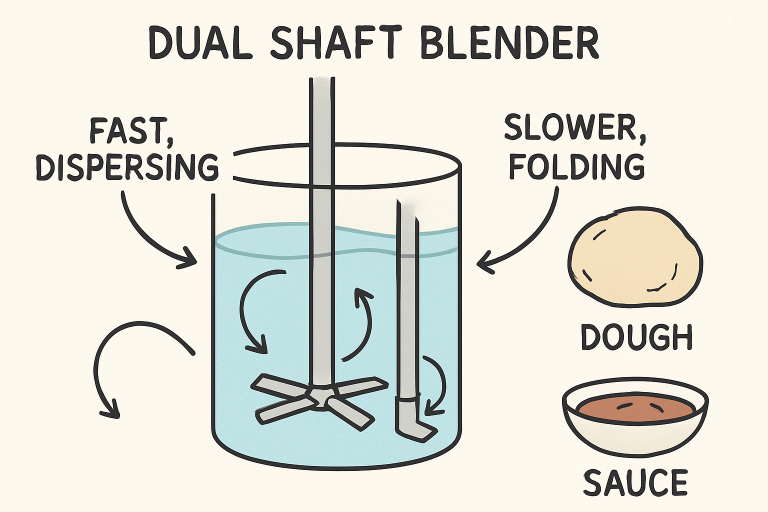
Dual shaft blenders, also called twin-shaft mixers, feature two independently driven shafts with distinct agitators. Typically, one shaft uses a high-speed disperser to break down lumps and rapidly mix ingredients. At the same time, the other employs a low-speed paddle or anchor agitator, gently folding in materials and scraping the vessel walls to ensure complete incorporation without overheating delicate components.
This dual-action approach makes them incredibly versatile, capable of handling everything from thin liquids to highly viscous slurries. The design is especially beneficial for products where texture, dispersion, and even blending are critical—areas that standard single-shaft mixers can sometimes struggle with, particularly as batch sizes or thickness increase.
Key Benefits in Food Production
- Enhanced Mixing Uniformity: The two-shaft system provides superior ingredient distribution, which is crucial for quality and repeatability. This uniformity is vital for industrial bakeries, sauce producers, and confectioners.
- Increased Efficiency: Dual-shaft mixers drastically reduce mixing times through optimized agitator designs, resulting in greater batch output in less time and lower operational costs.
- Versatility: These machines accommodate a wide range of foods—whether sticky doughs, chunky fillings, or fine batters—and are adaptable to rapidly changing product lines.
- Energy Efficiency: Modern mixer designs leverage more efficient motors and controls, minimizing energy use even at high capacities, which is especially appealing given growing energy sustainability demands.
Applications in the Food Industry
The robust and adaptable nature of dual shaft blenders makes them suited to a broad swath of food manufacturing sectors:
- Bakery: Widely used for evenly mixing dough and batters. By better incorporating air and thoroughly blending ingredients, these mixers deliver enhanced texture and crumb across breads, cakes, and pastries.
- Confectionery: Essential for blending sugar, dairy, cocoa, and other ingredients in confections and chocolates, ensuring every bite contains uniform flavor and texture.
- Prepared Foods: Ideal for sauces, dressings, dips, and spreads, delivering a smooth, creamy finish and consistent flavor in every batch.
Technological Advancements
Continuous improvements in dual-shaft blender technology have transformed their role in food production. Advanced features, such as high-shear rotor/stator mixing heads, have significantly enhanced these machines’ deagglomeration and emulsification capabilities, creating finer, more stable blends. The latest generation also features enhanced shaft seals and heavy-duty bearings, enabling higher throughput while minimizing unscheduled downtime from component wear.
Many modern blenders now include programmable controls and automated cleaning systems, further helping manufacturers meet food safety and allergen management requirements. As automation and digital monitoring become more prevalent in the food sector, advanced dual-shaft machines are often built with IoT-ready features for data tracking and process optimization.
Considerations for Implementation
- Product Characteristics: Before choosing a mixer, it’s crucial to assess the range of viscosities, ingredient types, and batch sizes typical for the production line. This evaluation ensures the equipment is neither under- nor over-specified for the required tasks.
- Batch Size: Selecting the correct mixing vessel capacity and motor size is key to maximizing throughput without sacrificing blend quality or causing excessive energy usage.
- Maintenance Needs: Look for machines with hygienic, easy-to-clean designs and accessible parts to streamline regular maintenance and reduce downtime. Simple machine access and tool-less disassembly can help manufacturers maintain stringent hygiene protocols while keeping equipment available for production.
Conclusion
Dual shaft blenders have evolved into must-have tools for modern food manufacturers, enabling both small-batch artisans and large-scale factories to achieve faster, more consistent, and more energy-efficient mixing. As food production environments grow more complex and demand higher quality standards, the versatility and advanced technology embedded within these mixers make them a crucial investment for any company intent on thriving in a fast-moving marketplace.